
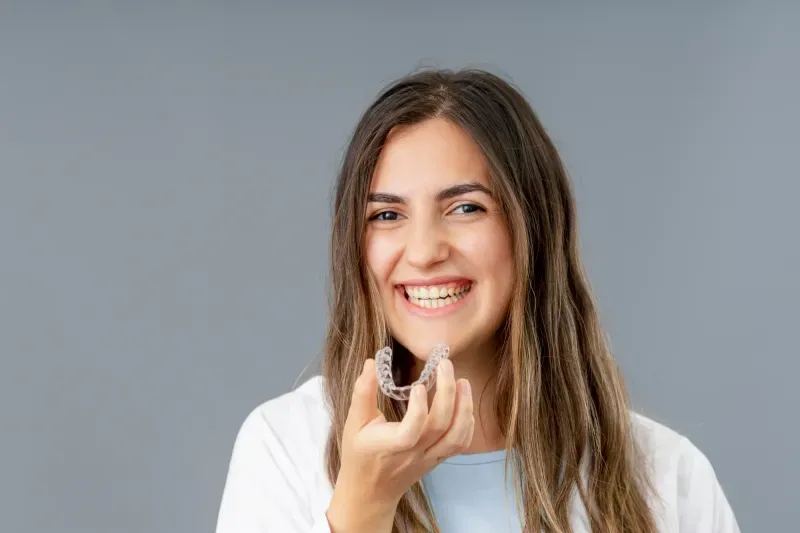
Most Invisalign treatment takes about 12 to 18 months, though minor corrections can finish in as little as 6 months and complex cases may run 2 years or more. Your timeline depends on how much your teeth need to move, your age, and — the biggest factor you control — how consistently you wear your aligners.
At Solana Orthodontics, Dr. Sandra Nairooz gives every Solana family member a realistic estimate at the start, based on a digital plan that maps each movement.
What is the average Invisalign timeline?
| Case complexity | Typical duration | Examples |
|---|---|---|
| Minor | 6–10 months | Small gaps, slight crowding, minor relapse |
| Moderate | 12–18 months | Crowding, spacing, mild bite issues |
| Complex | 18–24+ months | Significant bite correction, rotations |
What affects how long Invisalign takes?
- Wear time: aligners work only when they’re in — aim for 20–22 hours a day, every day.
- Case complexity: bigger movements and bite corrections take longer.
- Age: teeth in younger patients can move a bit more readily.
- Attachments & refinements: tricky movements may need extra sets to perfect.
Can you speed up Invisalign?
The safest way to stay fast is simple consistency: wear the aligners the full recommended hours, change on schedule, and keep your check-ins. Skipping hours is the number-one cause of a treatment running long. In our practice we often find that motivated aligner wearers finish right on — or ahead of — schedule.
What happens after Invisalign?
When your teeth reach their final positions, you move into retention with a retainer to hold the results. Understanding how Invisalign works helps explain why wear time matters so much throughout. As a board-certified orthodontist and diplomate of the American Board of Orthodontics, Dr. Sandra builds your plan — and your retention — around your goals. Curious what your timeline would look like? Book a consultation for Invisalign to see a custom estimate.
Does age affect how long Invisalign takes?
Age can play a modest role. In children and teens whose jaws are still developing, teeth sometimes respond a little more readily, and treatment can be coordinated with natural growth. In adults, the teeth and surrounding bone are fully mature, so certain movements may take somewhat longer, and long-standing issues can be more stubborn. That said, plenty of adults finish in a very reasonable timeframe — consistency with wear time matters far more than age for most cases. The bigger difference is that adult treatment focuses purely on the teeth and bite, since jaw growth can’t be used to help.
What can slow Invisalign treatment down?
A few common factors extend a timeline beyond the original estimate:
- Not wearing aligners enough — the number-one cause of delays, since teeth fall behind the plan.
- Skipping or losing aligners and not replacing them promptly.
- Teeth that track behind schedule, requiring refinement aligners to catch up.
- Complex movements like large rotations or significant bite correction.
- Missed check-ins, which delay catching and correcting small issues.
The reassuring flip side: nearly all of these are within your control, which means you have real influence over finishing on time.
How can you keep treatment on schedule?
Staying on track is mostly about steady habits. Wear each aligner the full 20 to 22 hours a day, switch to the next set exactly when directed, and use chewies to seat each tray fully so your teeth track as planned. Keep your scheduled visits so we can spot a lagging tooth early, and protect your aligners with a case so none are lost. In our practice we often find that motivated, consistent aligner wearers not only finish on time but sometimes ahead of the estimate.
What happens when Invisalign is finished?
When your teeth reach their planned positions, treatment transitions to retention. You’ll wear a retainer to hold your results — full-time for a few months, then nightly for the long term — because teeth naturally try to drift back afterward. Any attachments are polished off, and we confirm your bite is settling correctly. Building retention into the plan from the start is what ensures the time you invested in aligners produces a smile that lasts for years.
Is a longer treatment time a bad sign?
Not at all. A longer timeline usually just reflects a more complex case, not a problem. What matters is steady progress toward a healthy, stable result — rushing tooth movement can compromise the outcome or the health of the roots and gums. A realistic timeline planned by a board-certified orthodontist is designed to move your teeth safely and predictably, and we’ll keep you updated on your progress at every visit so you always know where you stand.
Does Invisalign take longer for teens or adults?
For comparable cases, teen and adult timelines are often similar, but the nuances differ. Teens may benefit from ongoing jaw growth and typically have specific compliance features built into their aligners, though busy schedules can affect wear time. Adults have fully mature bone, so certain movements can take a little longer, but adults often excel at the consistency aligners demand. In both groups, the deciding factor is almost always wear time rather than age — the patients who keep their aligners in 20 to 22 hours a day are the ones who finish on schedule.
How does Invisalign timing compare to braces?
For many mild to moderate cases, braces and Invisalign finish in a broadly similar window. Braces can be more efficient for certain complex movements because they’re fixed and always working, while Invisalign depends on your discipline with wear time. Neither is universally faster — the honest answer is that it depends on your specific bite and habits. A consultation, where we map the movements your teeth actually need, is the only way to get a timeline you can trust rather than a generic estimate.
Can you get a personalized Invisalign timeline?
Yes, and it’s the best way to set expectations. Using a digital scan, we plan every movement from start to finish, which lets Dr. Sandra give you a realistic range for your case rather than a one-size-fits-all number. You’ll also get a clear picture of what’s driving the timeline — whether it’s the complexity of your bite, the number of aligners needed, or the refinements we anticipate. Knowing the “why” behind your timeline makes the whole process feel far more predictable.
Getting your personalized Invisalign estimate
General timelines are a helpful starting point, but nothing beats an estimate built from your actual teeth. Using a digital scan, we map every planned movement and give you a realistic range for your case, along with what’s driving it. You’ll know roughly how many aligners you’ll wear and what to expect at each stage. If a predictable timeline matters to you, a consultation is the best next step — it replaces guesswork with a clear plan you can count on from start to finish.
Frequently Asked Questions
Is Invisalign faster than braces?
For many mild to moderate cases the timelines are similar. Braces can be more efficient for some complex movements. A consultation is the only way to compare for your specific bite.
What happens if I don’t wear my aligners enough?
Teeth fall behind the plan, aligners stop fitting well, and treatment stretches out — sometimes requiring extra sets. Consistent wear is the key to finishing on time.
How often do I change aligners?
Usually every one to two weeks, based on your personalized plan. We’ll tell you your exact schedule.