
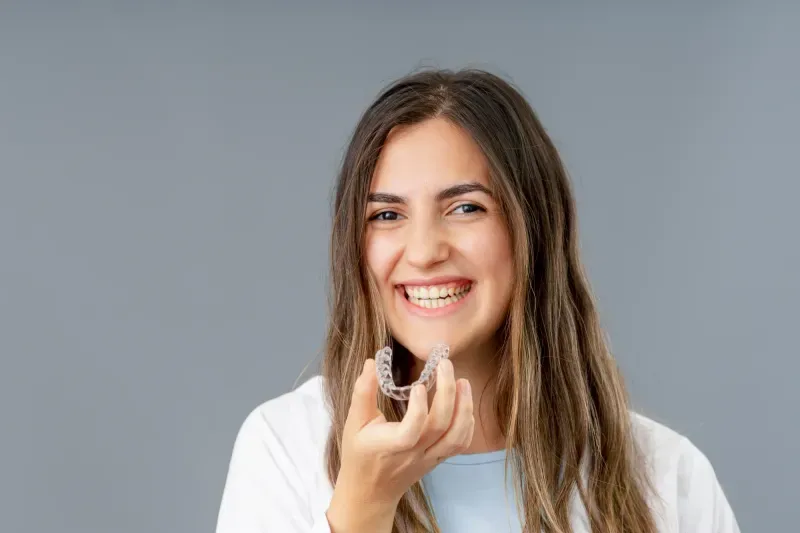
Invisalign works by using a series of custom-made clear aligners that apply gentle, precise pressure to move your teeth a little at a time. You wear each set for about one to two weeks, 20 to 22 hours a day, then switch to the next in the series. Over the course of treatment, the aligners guide your teeth from their starting position to a straight, healthy bite.
At Solana Orthodontics, Dr. Sandra Nairooz plans every aligner sequence digitally, so each Solana family member can see the finish line before treatment even begins.
How do the aligners move your teeth?
Each aligner is shaped slightly differently from your current teeth. When you put it on, it puts light pressure on specific teeth, encouraging them to shift toward the planned position. As one movement completes, the next aligner picks up where the last left off. It’s the same biological principle as braces — controlled force over time — delivered through a smooth, removable tray instead of brackets and wires.
What are the steps of Invisalign treatment?
- Digital scan & plan: we take a 3D scan of your teeth (no goopy molds) and map every movement from start to finish.
- Custom aligners made: your personalized series is manufactured to match the plan.
- Wear & switch: wear each set 20–22 hours a day, changing to the next about every one to two weeks.
- Attachments if needed: small tooth-colored bumps give the aligners extra grip for tricky movements.
- Check-ins: we monitor progress and make refinements as needed.
- Retention: once your teeth are aligned, a retainer holds the results.
What can Invisalign fix?
Modern Invisalign treats many of the same issues as braces — crowding, gaps, overbites, underbites, crossbites, and more. Very complex bites may still be better served by braces, which is exactly what a consultation determines. In our practice we often find that patients are surprised how much aligners can accomplish today.
Why does wear time matter so much?
Aligners only work while they’re on your teeth. Wearing them the full 20 to 22 hours a day is the single biggest factor in staying on schedule. Take them out to eat and to brush, then put them right back in.
As a board-certified orthodontist and diplomate of the American Board of Orthodontics, Dr. Sandra Nairooz brings the same bite expertise to aligners that she brings to braces. If you’re considering Invisalign in San Antonio, a consultation is the best way to see your custom plan. Still deciding between options? Our comparison of Invisalign vs. traditional braces can help.
What are Invisalign attachments and refinements?
Two features help modern aligners handle more complex movements than the aligners of a decade ago. Attachments are tiny tooth-colored bumps of bonding material placed on specific teeth; they give the aligner something to grip so it can rotate, extrude, or precisely control a tooth that a smooth tray alone couldn’t move well. They’re barely noticeable and are removed at the end of treatment. Refinements are a second (sometimes third) set of aligners made near the end of treatment to perfect the final result — a normal, planned part of many cases, not a sign anything went wrong. Together, attachments and refinements are a big reason today’s clear aligners can treat cases that once required braces.
What does daily life with Invisalign look like?
Living with aligners is straightforward once it becomes routine:
- Wear them 20–22 hours a day, removing only to eat, drink anything but water, and brush.
- Take them out for meals so you can eat normally, with no food restrictions.
- Brush before reinserting so food and sugar aren’t sealed against your teeth.
- Rinse and clean the aligners daily to keep them clear and odor-free.
- Carry your case everywhere — wrapping aligners in a napkin is the fastest way to lose them.
Most patients settle into the rhythm within a week, and the freedom to remove aligners for meals and special occasions is the feature they appreciate most.
How is the Invisalign mechanism different from braces?
Braces and Invisalign both move teeth with controlled force, but they deliver it differently. Braces use brackets bonded to each tooth and a wire that the orthodontist adjusts, applying continuous force that’s always working. Invisalign uses a sequence of removable trays, each programmed for a small set of movements, so the “adjustment” happens every time you switch to the next aligner. Braces are fixed and don’t rely on your memory; aligners depend on you wearing them enough. Neither is universally better — the right choice depends on your case and your habits.
Who is a good candidate for Invisalign?
Invisalign works well for a wide range of patients — teens and adults with crowding, spacing, and many bite issues do great with it. The most important candidacy factor is often commitment to wear time, since the trays only work while they’re in. Very complex bites, certain severe rotations, or cases needing significant jaw coordination may still be better served by braces. The only way to know for sure is an evaluation. In our practice we often find patients are pleasantly surprised by how much aligners can accomplish today, but we’ll always tell you honestly if braces would give you a better result.
What happens after Invisalign treatment?
Finishing your aligners isn’t quite the end — it’s the transition to retention. Once your teeth reach their final positions, you’ll wear a retainer to hold them there, because teeth naturally try to drift back toward where they started. Most patients wear a retainer full-time for a few months, then nightly for the long term. Any attachments placed during treatment are polished off, and we’ll confirm your bite is settling in as planned. Retention is what turns months of aligner wear into a result that lasts.
How do you stay on track with Invisalign?
Because aligners are removable, success depends more on your habits than with braces. A few things keep treatment moving:
- Hit your wear time — 20 to 22 hours a day, every day, is the single biggest factor.
- Switch on schedule — change to the next aligner exactly when directed.
- Use chewies — small foam cushions you bite on help each aligner seat fully.
- Keep your check-ins so we can catch a tooth that’s tracking behind early.
- Never lose momentum — if an aligner is lost, call us rather than skipping ahead.
Why choose an orthodontist for Invisalign?
Invisalign is a tool, and results depend heavily on the training of the person planning your movements. As a board-certified orthodontist and diplomate of the American Board of Orthodontics, Dr. Sandra Nairooz brings years of specialized education in tooth movement and bite mechanics to every aligner plan — the same expertise she brings to braces. That means the digital plan is designed around a healthy bite, not just straight-looking front teeth, and any mid-course corrections are handled by a specialist. Choosing an orthodontist gives your aligner treatment the best chance of a stable, functional result.
Is Invisalign the right choice for you?
The best way to know whether clear aligners suit your smile is a professional evaluation. Many patients who assume they need braces are excellent aligner candidates, while some complex cases are better served by braces — and only an exam can tell the difference for your specific bite. At Solana Orthodontics, Dr. Sandra Nairooz reviews your goals, examines your teeth and bite, and gives you honest guidance so you can choose with confidence. Understanding how the treatment works is the first step; a consultation turns that understanding into a plan built around you.
Frequently Asked Questions
How long does Invisalign take to work?
You’ll see small changes within the first few sets, but full treatment usually takes several months to a couple of years depending on your case and how consistently you wear the aligners.
Does Invisalign hurt?
Expect mild pressure or tenderness for a day or two with each new aligner. It’s a sign the aligner is working, and it fades quickly.
Can I take Invisalign out for special occasions?
Yes — that’s a key advantage. Just limit time out of the trays to meals and brushing so you stay on track.