
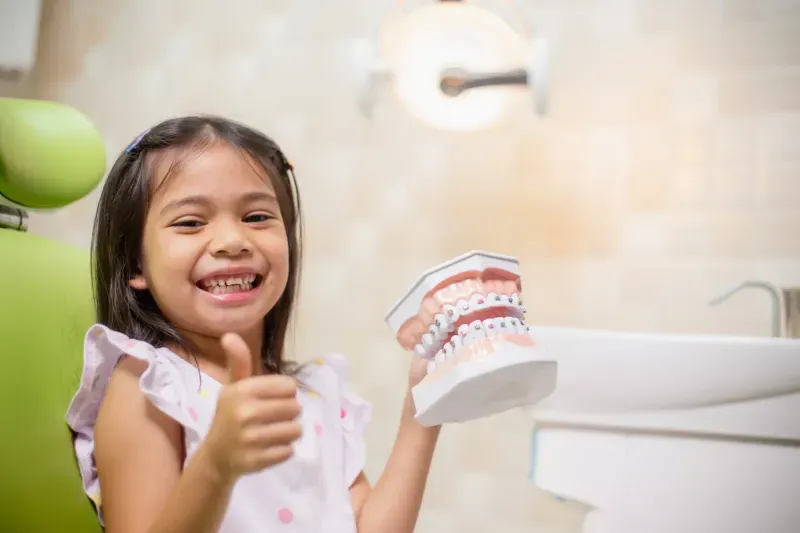
Your child should first see an orthodontist by age 7. The American Association of Orthodontists recommends this timing because enough permanent teeth have come in to spot developing issues like crossbites, crowding, or jaw growth concerns. Most young patients won’t need braces yet, but this complimentary consultation at Solana Orthodontics gives Dr. Sandra Nairooz a baseline to monitor growth and step in at the right time, if needed. Families across San Antonio and Universal City trust this early checkpoint to set their children up for healthy smiles.
At age 7, your child’s mouth is a mix of baby and adult teeth. That blend is exactly what makes this age so revealing. A board-certified orthodontist can see how the jaw is developing, how permanent teeth are erupting, and whether the bite is settling into a healthy pattern.
You don’t need a referral from your dentist to schedule this visit. Parents can book directly with our practice. Many Solana family members come in simply for peace of mind, leaving with a clear picture of what (if anything) to watch for as their child grows.
How an Early Orthodontic Evaluation Works
An early orthodontic evaluation is a short, friendly visit where Dr. Sandra Nairooz reviews how your child’s teeth are erupting, how the jaw is growing, and how the bite fits together. Digital scans or low-dose images may be used to see teeth still under the gums. Most visits end with a simple monitoring plan, not treatment. It’s a welcoming first step for families throughout San Antonio.
Here’s what you can expect during your child’s first visit:
- A gentle clinical exam. Dr. Sandra checks for crowding, spacing, crossbite, overbite, underbite, and how the upper and lower jaws relate.
- Digital impressions or 3D ultra-low dose imaging. These tools help us see what’s happening beneath the gums without anything messy or uncomfortable.
- A growth and development review. We look at tooth eruption patterns and signs of habits like thumb-sucking or mouth breathing that may shape the bite over time.
- A conversation with you. We’ll walk you through what we see, answer your questions, and explain what (if anything) to watch for.
- A recommendation. Most young patients are placed on a “watch and grow” plan with check-ins every 6 to 12 months. If early Phase 1 care is helpful, we’ll explain why and how.
The visit is usually quick, low-pressure, and designed to feel welcoming for kids. We’re an open book, so you’ll leave knowing exactly where your child stands.
Benefits of an Early Orthodontic Visit
An early visit isn’t about rushing into braces. It’s about giving your child the best foundation while their jaws and teeth are still developing. When we can guide growth, rather than correct it later, the orthodontic journey is often simpler and shorter.
Here’s how an early evaluation can help your child:
- Guides jaw growth to create room for permanent teeth as they come in.
- Reduces the risk of impacted teeth and lowers the chance of needing extractions later.
- Corrects harmful habits like thumb-sucking, tongue thrusting, or mouth breathing before they reshape the bite.
- May shorten or simplify future treatment with braces or Invisalign during the teen years.
- Addresses airway and breathing concerns when a narrow palate or restricted airway is affecting sleep or focus.
- Builds confidence by managing visible crowding, gaps, or protruding teeth at an age when kids are starting to notice their smiles.
Catching small issues early often means fewer, easier steps later. Early intervention can sometimes prevent more involved orthodontic care down the road. That’s a real gift for your child, and a real time-saver for busy families.
Early Treatment vs. Waiting Until Later
Early treatment is usually recommended when skeletal issues like crossbites, underbites, or a narrow palate are involved, since growth can be guided while the jaw is still flexible. Waiting until the teen years often works better for mild crowding or simple bite refinement. The age-7 evaluation reveals which path fits your child best.
| Phase 1 (Early Treatment) | Phase 2 (Comprehensive Treatment) | |
|---|---|---|
| Typical Age | 7-10 years old | 11-15 years old |
| Primary Goal | Guide jaw growth, correct skeletal issues, create space | Align all permanent teeth and finalize the bite |
| Common Appliances | Palatal expanders, partial braces, space maintainers, habit appliances | Full braces or Invisalign |
| Best Candidates | Crossbite, underbite, severe crowding, narrow palate, harmful oral habits | Crowding, spacing, bite refinement after permanent teeth erupt |
| Typical Duration | 6-18 months, followed by a resting period | 12-24 months |
Early treatment works best when skeletal issues are involved, because we can shape growth while jaws are still flexible. If your child only has mild crowding and a healthy bite, waiting until more permanent teeth come in is often the smarter call. The age-7 visit is what tells us which group your child falls into.
What Affects the Cost of Early Orthodontic Care?
The cost of early orthodontic care depends on whether your child only needs monitoring or active Phase 1 treatment. At Solana Orthodontics, the first complimentary consultation is free, so you can get clear answers before committing to anything. Active care costs vary based on appliance type, treatment length, and complexity, and we make pricing transparent for every family we serve across San Antonio and Universal City.
A few factors that shape the total investment:
- Monitoring vs. active treatment. “Watch and grow” check-ins are minimal in cost. Phase 1 treatment with appliances is a larger investment that pays off in simpler care later.
- Appliance type and complexity. A palatal expander, partial braces, or habit appliance each carry different costs, and we’ll match the right tool to your child’s needs.
- Dental insurance. Many plans include an orthodontic benefit that can offset part of evaluation or treatment costs, and our team will help you understand what your coverage includes.
- Personalized payment plans. We offer flexible financial options designed around busy family budgets, because boutique doesn’t mean more expensive, it means more attention to you.
We’ll always walk you through the full cost in plain language before any treatment begins. There are no surprise fees and no pressure, just honest guidance so you can make the choice that feels right for your family.
Signs Your Child May Need an Orthodontist
Some kids show clear signs that an orthodontic evaluation is overdue. Others look fine on the outside while small issues develop underneath. That’s why the age-7 visit matters even when nothing seems “wrong,” and it’s the simplest way to answer the question of what age your child should first see an orthodontist.
Watch for these common signs:
- Your child just turned 7. This is the recommended age for a first evaluation, no symptoms required.
- Crowded, gapped, or overlapping teeth that are visible when your child smiles.
- Does your child struggle to chew or bite food comfortably? That discomfort can signal a developing bite issue.
- Mouth breathing or snoring, which may signal airway concerns worth a closer look.
- Baby teeth that fall out early or late compared to siblings or classmates.
- Thumb-sucking past age 5, which can shift the front teeth and palate.
- Jaws that shift, click, or pop when your child opens or closes.
- Protruding front teeth, a visible underbite, or an overbite that’s becoming more pronounced.
If any of these feel familiar, a quick evaluation can either bring reassurance or set up a clear plan. Either way, you’ll have an answer.
Frequently Asked Questions
Is age 7 too early for braces?
Age 7 is the right time for an evaluation, not necessarily for braces. Most young patients leave their first visit with a monitoring plan, not appliances. The goal is to spot any growth or bite concerns early, while baby teeth are still in place and jaw development is active.
Does my child need a dentist referral to see an orthodontist?
No referral is needed. You can self-schedule directly with Solana Orthodontics. Many families come in on their own after noticing crowding, an unusual bite, or simply because their child has reached age 7. Your child’s general dentist is a great partner, but you don’t have to wait for one to send you our way.
How long does early treatment last?
Phase 1 treatment typically lasts 6 to 18 months, depending on what we’re correcting. After that, there’s usually a resting period while the remaining permanent teeth come in. If a second phase with braces or Invisalign is needed later, it’s often shorter and simpler because of the groundwork laid early on.
Will early treatment prevent braces later?
Sometimes, but not always. Early care can reduce the complexity of later treatment and, in some cases, eliminate the need for it. Early intervention can prevent more serious problems from developing. For many kids, though, a short second phase of braces or Invisalign as a teen still gives the most polished final bite.
What if we miss the age-7 window?
An evaluation is still valuable at any age. Older children, teens, and adults all benefit from an orthodontic assessment. If your child is 9, 12, or even older, you haven’t missed anything important, you’ve just arrived a little later. Dr. Sandra will meet your child exactly where they are.
How often are follow-up visits during monitoring?
Most “watch and grow” patients come in every 6 to 12 months. These check-ins are quick and let us track jaw growth and tooth eruption over time. If anything changes, we’ll talk through your options well before treatment becomes urgent.
Ready to schedule your child’s first orthodontic visit? Dr. Sandra Nairooz, DDS, MSD, is a board-certified orthodontist and Diplomate of the American Board of Orthodontics with years of clinical experience caring for young patients. As an active member of the AAO, ADA, TDA, San Antonio District Dental Society, Texas Association of Orthodontists, and American Lingual Orthodontic Association, Dr. Sandra brings deep expertise and genuine warmth to every visit. At our boutique-style practice, you are not just a number, you are a Solana family member. Book your complimentary consultation today and find your radiance with Solana Orthodontics.